About
the Anti‑Racist Partnership Agreement
The Centre for Equity & Inclusion is a research hub based within the University of Sheffield. We seek to dismantle structures of racial oppression operating within and beyond higher education. As a collective of researchers, artists, educators, and community leaders, we collaborate on creative projects that reimagine harmful university processes and practices.
When the Centre first launched in 2022, we identified the key processes that would underpin our work together. We recognised that any collaboration could only be as equitable as the processes shaping it. Partnership agreements are often established at the very beginning of a project, to make explicit the terms and conditions of a working relationship for all key stakeholders. Though generally considered good practice, our experience told us that partnership agreements often reinforce hierarchies and reproduce various harms. We decided that a new model was needed.
In September 2022, the Centre commissioned artist and legal practitioner Jack Ky Tan to develop an anti-racist partnership agreement. Jack facilitated a series of workshops with Centre partners and PhD students of colour to identify issues with current agreements and explore possible alternatives. Those taking part came from a range of racial, cultural and gendered backgrounds, and the idea was to draw insights from these distinctive lived experiences and knowledge systems.
During the first workshop, participants examined the default agreement used by the University of Sheffield. The tone was immediately jarring. Legal clauses created a feeling of “us and them”, concerned with protecting the institution and punishing external collaborators for any perceived wrongdoing. There was no attempt to unify partners over a common purpose, or to cultivate compassion between them.
Participants also found language to be a problem. The dense paragraphs and legal jargon was inaccessible and exclusionary. When reimagining alternative frameworks for individual clauses, many participants wanted to draw from their own cultures. But translation was becoming an issue. These frameworks lost their essence when communicated in English. As a result, the workshop ended with the group deciding to produce a visual partnership agreement .
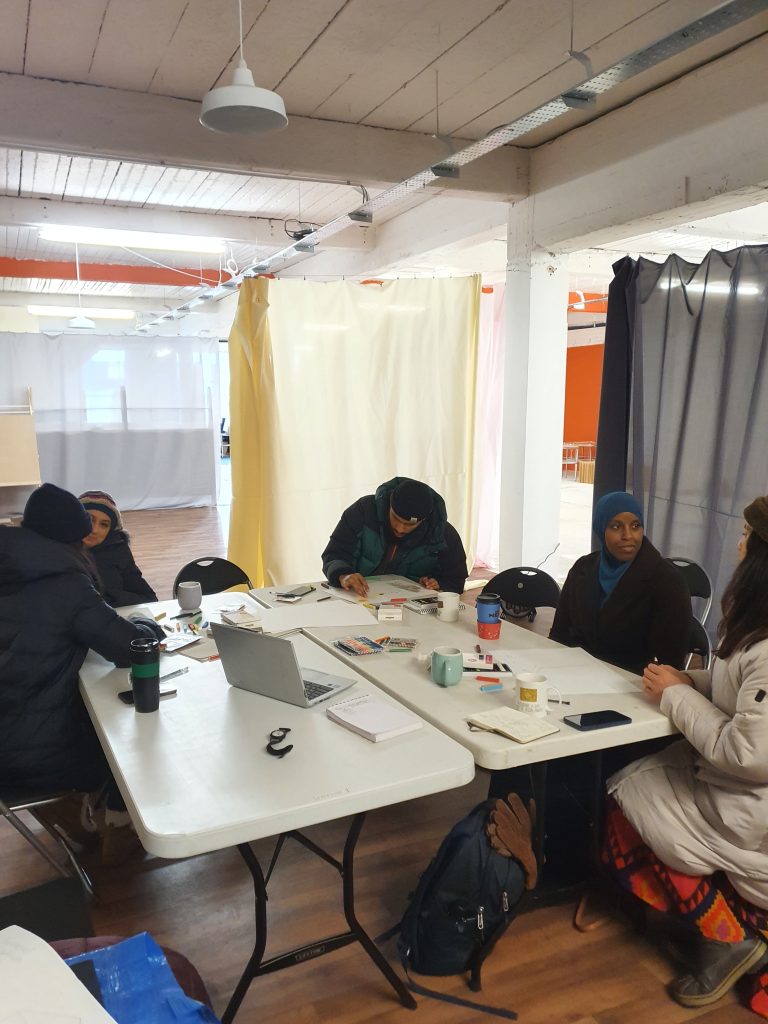
For the second workshop, Jack presented research on equitable and decolonial cosmologies of partnership work. He provided historic examples of visual contracts such as the Kudurru and Quipu. This prompted the development of our own visual partnership agreement. Each participant took a clause from the University’s existing agreement, thought about an alternative model from their own cultural background, and captured it by drawing an image. This was discussed in pairs and shared with the wider group.
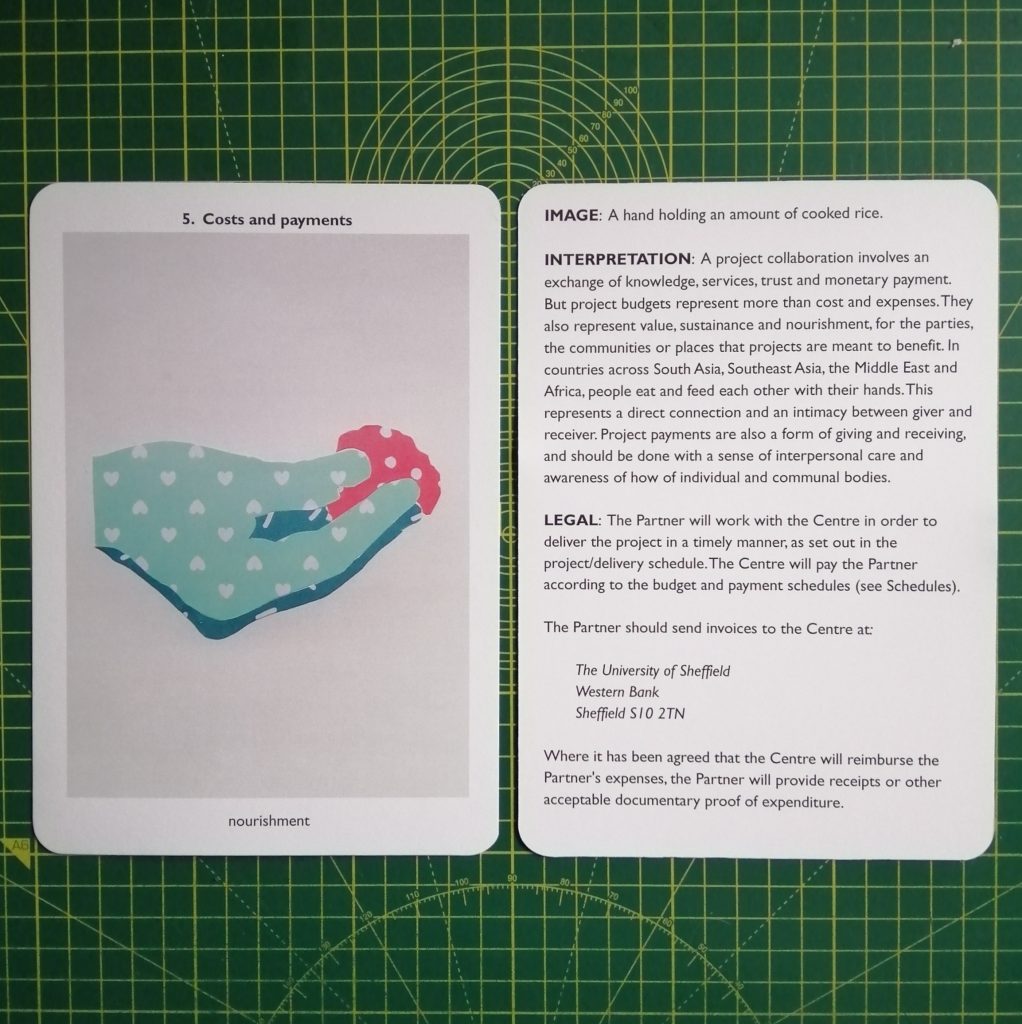
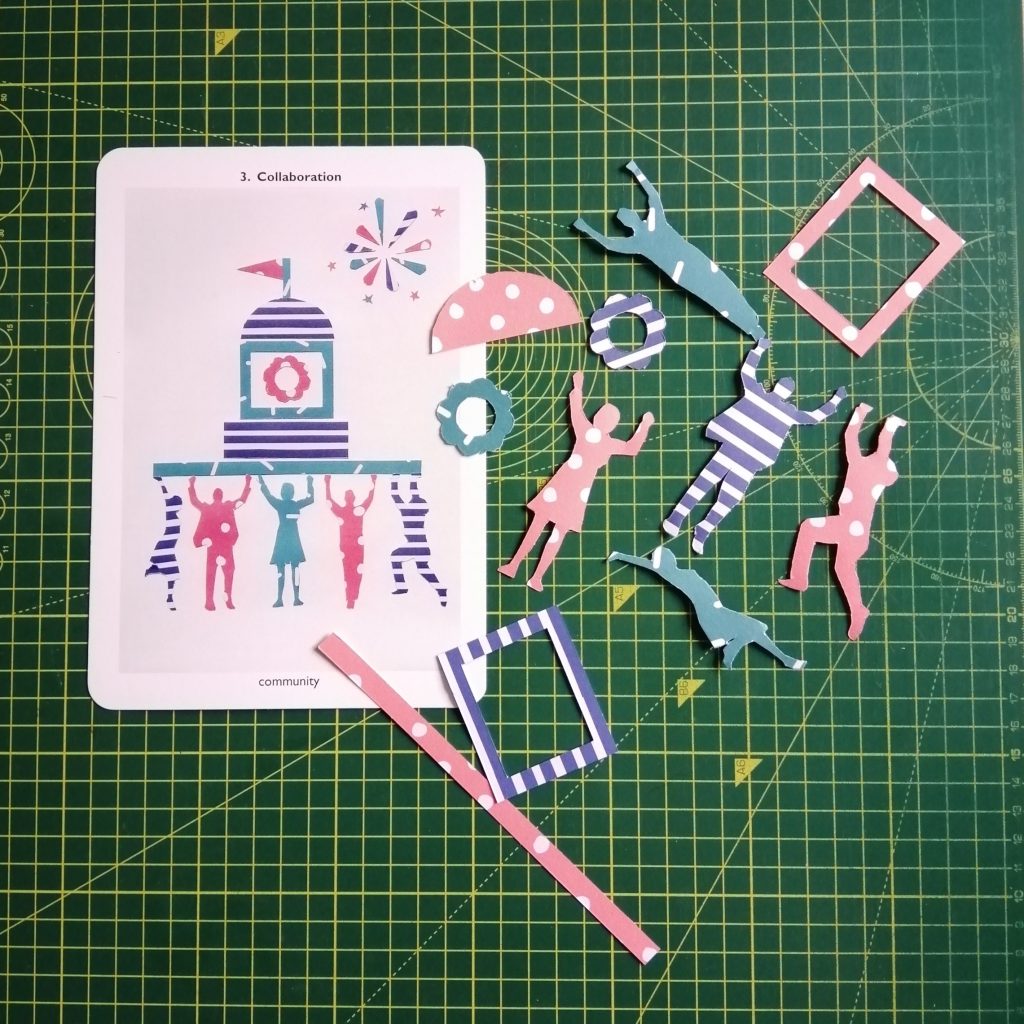
Jack then spent several months refining the draft images and creating many of his own through the practice of decoupage. He also crafted supplementary text to provide guidance on how to interpret the images. He then formatted the final designs into playing cards, which were presented to workshop participants.
This partnership agreement was launched at a public event in September 2023. Attendees included people from across the UK working in areas relating to public engagement, anti-racism and the arts. It is now being used in all CEI steering group meetings and Knowledge Exchange projects as part of a one-year piloting process. Results will be shared with the University of Sheffield as we map out a wider implementation process within the institution.
Our visual contract is an agreement that foregrounds the intentions or principles behind words, and gives enough specificity without erasing the humanity of the partnership and the parties’ lived ethnic or embodied realities.
As phase one of this project came to an end, we invited CEI project manager Alex Rajinder Mason and artist Jack Ky Tan to discuss the purpose behind it in more detail. Their discussion can be found below.
Alex: When I joined Arts & Humanities Knowledge Exchange, some years ago, I set about trying to create a partnership agreement that would benefit marginalised communities. It was my view that conventional agreements did very little to protect them. They never mentioned power or addressed the issues that typically cause harm. Quite the opposite in fact. They consolidated the conditions for severe harm and exploitation.The version that I created sought to undo this but it was somewhat limited in scope. I didn’t have enough knowledge around the law and I realised issues around power, accountability, dispute resolution, etc. required thinking through with others. When the Centre for Equity & Inclusion launched in 2022, myself and the Centre partners agreed this was a good opportunity to develop something more transformative and practically useful. We recognised that in order for us to work meaningfully together we would need to address the policies underpinning our work. One partner recommended we get in touch with you, as someone who is both an artist and legal practitioner. We felt applying the arts to anti-racism work was important. It would allow us to push boundaries, better experiment with alternatives, and take a more holistic approach.
Alex: Why is it important to critically assess processes (legal or otherwise) in community partnership work? How do the arts aid this process?
Jack: Processes aren’t value-neutral. They are an intersection of how you behave (the performative), the things/spaces/tools you work with (the material) and the quality of engagement between the people/entities/actors involved (the relational). But the performative, the material and the relational come laden with their own history, meaning, embodied memory, custom, ideology and more. Unlike, say, product manufacture processes, community organisations represent even more complex intersections where political, economic, emotional, collective memory and social justice factors come into play in dynamic ways.
I have a background in ceramics and law: two disciplines where process is crucial in determining the quality and indeed the viability of the outcomes. Every potter knows that the clay ‘remembers’ the movement of the hand that moulds it, and every lawyer understands that due process and due diligence is crucial to prevent outcomes from being challenged.
A big part of my practice combines art and law, where I consider law (which to me includes all formal and informal rules) as a form of artistic medium or ‘clay’. When I work with organisations, I think of them as a form of bureaucratic or administrative sculpture where their rules are the core medium or structure which holds together everything that makes organisations what they are: their performativity, their materiality, their relationality.
To me as an artist, I consider that organisations need to achieve a kind of bureaucratic poiesis to be able to function well and to be useful in the world. By poiesis, I mean something like, but not limited to, how an artwork comes into its own, or gains a life of its own, that is independent from its creator. It ‘zings’ as it were and achieves an emanation from ground to world.
The problem arises when what an organisation wants to do, or why it wants to do something (i.e., its mission, vision and values if you will) doesn’t fit with how it goes about doing this (i.e., its processes). Take for example, that a grassroots community arts organisation suddenly obtains a large amount of sustained public funding (say some 10 times its early years income). It then decides to hire a ‘C-suite’ of senior management, who by their nature, explicitly or unwittingly, imposes a global or globalising organisational culture. However, all the while, the organisation still espouses that its primary charitable purpose is to stay local, to reach the marginalised and to champion its originating community of artists.
Here the organisation’s aims and its processes are in a constant fight with each other. It would be as if someone were trying to get across a shallow pool by trying to run along the bottom as a technique rather than to swim through the water. Or more specifically for me, it would be as if I was trying to create a very thin translucent porcelain-style pot while using earthenware clay. I still can get across the pool eventually or make a delicate white earthenware pot, but why not make it easier for myself by making sure that my aims and values match my processes?
As an artist, I think creative people are experts in understanding how to achieve that sweet spot between practical or technical process and something’s relevance to society or its ‘zing’, i.e., between praxis and poiesis, be this in the production of an art object or in working with communities.
Alex: Could you summarise your process of putting together the visual contract?
Jack: We didn’t aim to create a visual contract initially. In fact, we didn’t even know that such a thing was possible. Back in June 2022, when we first met, you had asked me to review your existing boilerplate partnership agreements and to draft a new and more equitable one: something similar to this artists’ contract I had created in the past.
But what struck me was how you understood that institutions can and should be conceived in a different way. Particularly for Sheffield University’s Centre for Equity and Inclusion, where the focus is to create training and resources for global ethnic majority postgraduates and community groups, you were alert to how your existing processes might be replicating systemic inequalities and harm. You also asked how institutions could be accountable. Not something I hear a lot from university research centre representatives and so I was intrigued to work with you.
We began with a workshop where we discussed what ‘partnership’ meant to the participants from their own native or heritage cosmological perspectives and how these can be incorporated into a partnership contract. We talked about Somali decision-making circles, Jamaican sound systems as being together, Flamenco as body listening, the Romani Kris legal system, Feng Shui which focuses on the flow between people and things.
But we soon discovered that not only was it hard to articulate these philosophies and values in the legal language, it was almost impossible to do so in the English language too. Something in the structure and use of English tended to articulate and call into being English subjectivities and therefore English ways of relating. We decided that the way round this was to create a contract where English and legal language could be sidestepped to make way for an articulation of the participants’ own value systems. Hence we settled upon the idea of a visual contract.
We came together again in a second workshop where we took the boilerplate contract clauses, and drew them (using coloured pencils, crayons, charcoal and felt-tips on paper) in a way that expressed participants’ cosmologies. Then using this as source material and a guide, I drafted a new contract for you where each clause consisted of three parts: a leading image, the image’s history and explanation, and an accompanying legal interpretation. I chose decoupage, a 12th century Chinese art form of decorating functional objects with paper cut-outs as the image-making technique, because it represented the way such a diverse group of seemingly unrelated participants was joining forces to create something new together.
Alex: What is the significance of making this a visual contract?
Jack: This isn’t the first time the legal has been encapsulated in the visual or artistic. Babylonian Kudurru were standing stones that legally granted title in property and were engraved with contractual clauses that were images. Inca ‘quipu’ were knotted strings that were used as a formal accounts system instead of writing. In places like Greenland and Malta, Song Duels were entirely binding musical litigation processes. Indeed the significance of the visual is seen in our own courts where the British State’s coat of arms hangs above the Judge’s seat.
In our visual contract, as in these examples, there is a move from the representational and purely positivistic towards the symbolic, i.e., a move from the letter of the law, to allow more space for the spirit of the law. This means acknowledging that partnerships, especially ones between institutions and communities, can’t be reduced to a specific set of narrow rules to be followed to the letter. That kind of contract would be enormous, have to contain many exceptions and be revised often. Instead, our visual contract is an agreement that foregrounds the intentions or principles behind words, and gives enough specificity without erasing the humanity of the partnership and the parties’ lived ethnic or embodied realities.
Alex: How did anti-racist and/or decolonial theory inform the development of the contract?
Jack: I have moved away from practices of “anti-” or “de-” or “post-”, even though I still use these prefixes as a shorthand, and more towards an “anti/de/post+” approach. Since the 60s, civil rights movements and post-structuralist theories have been effective at deconstructing and critiquing inequality. I would consider the Black Lives Matter, Stop Asian Hate and Me Too movements part of this. These, shall we say ‘minus’ approaches, are only half the story. While it is necessary to identify and challenge systematic oppressions and to remove barriers to access, we need to pair this work of clearing the ground with ‘plus’ approaches of worldplanting or worldbuilding. It has to be two actions in one gesture.
Here our visual contract both negates the colonial, hierarchical, heter/neuro-normative while manifesting the more-than-colonial, entangled, queer and multi-able at the same time. But the ‘plus’ being manifested isn’t just a substitute of the same again but just with different content. Instead the visual contract is interpellating the parties into a radically different relationality and legal ontology. In other words, the contract doesn’t just ask you to use global ethnic majority traditions or concepts, it asks you to embody them too.
As for theory, my archive is constantly growing or shrinking. But certain figures continue to haunt my practice and this work. Cultural theorist Stuart Hall’s idea of internationalism still informs how I consider diasporas from different nations, like in our group, can collaborate with each other in mutuality. Black studies scholars Fred Moten and Stefano Harney’s work on the undercommons underpins how I relate to a Russell Group university like Sheffield University without being co-opted. Their work on Black governance and planning is also particularly helpful when working out how to transform regulatory tools such as contracts.
Further, I consider that we operate in a neverending plantation of colonial and patriarchal structures that endlessly self-propagates; this becomes a sublime of colonialism and an aporia of racial capitalism if you will. And for me, aporia cannot be overcome through logic or cleverness, but through (self-) transformation. Here anthropologist Anna Tsing’s work on the way matsutake mushrooms survive in a landscape of capitalist pine plantation gives me inspiration on how we can not only survive but thrive in the neo-colonial landscape.
It is also worth noting that like Tsing’s mushrooms, I don’t believe that we can get out of the plantation. There is no de-colonial utopia or Eden to which we can reset the world as if the racial global capitalism of the 18th century didn’t happen and isn’t continuing to happen. But Tsing’s mushroom methodology doesn’t just point to bare survival but also to the possibility of thriving in spite of (racial) capitalism: through infection, parasitism (lit. to eat at another’s table), transience, fugitivity and coalition-building. I regard this visual contract as potentially such a mushroom bloom that grows in, on and through the plantation of institution.
Jack: Were there any particular points of note, interest, or excitement that emerged from the workshops with partners/PGRs?
Alex: I was really taken with how organic the workshop process was. Although we entered into the workshops with the general idea of creating an anti-racist agreement, there was very little premeditation about what form this would take. Ultimately what came out was a reflection of the particular people in the room. Our politics, our cultural backgrounds, our previous experiences working in partnerships, our ability to imagine something different and then draw it. And of course your creativity! For example, the focus on the visual emerged from a discussion about how some of the Somali concepts we were trying to adopt wouldn’t translate into English. It then grew because one of the participants had used South Asian symbols and imagery when establishing the principles of their grassroots organisation. A different set of people would have produced almost an entirely different contract. I think that’s important because one of the key things we identified was the need for this contract to reflect the fluidity, malleability and aliveness of a partnership.
I should also say that I loved huddling together, on a very cold November day, drawing some of the images that would be used for the contract. I am terrible at drawing, but there was something simultaneously focusing and freeing about putting pencil to paper and creating crude images that would capture the essence of our transformed legal clauses. Sitting together in this way, and then sharing our work with the group, engendered a lot of reflection and also a lot of laughter. It brought us closer together as partners. My background is in literature so I am already convinced of the importance of the arts to anti-racist work, but it was nice to be reminded of it again.
Jack: What do you hope this contract achieves, or helps to achieve?
Alex: My ambition for the Centre is always that it leads to positive, material change. While a contract cannot do everything to combat harmful university systems, I hope it helps the Centre to engage in more healthy, life affirming collaborations. We have only been using it for a couple of months so far but I can already see it making an impact. It encourages a more conscientious approach to the day-to-day of partnership work. It provides a platform for people to raise issues, check in with their own and others’ wellbeing, and to think more deeply about existing and emerging relationships.
I am not necessarily looking for others to adopt this exact contract in their own work, though I am open to that. My main hope is that they are inspired by the process described above and set out to create their own version. How cool would it be if we saw a range of contracts that centred anti-racism and captured cultural knowledges and traditions from around the world in new and distinctive ways? I think together it would give us a richer and more liberating approach to partnerships.
Ready to play?